The Zero-Joint Kitchen: Integrating Porcelain Slabs for Sinks, Backsplashes, and Waterfalls

Introduction: The Monolithic Paradigm of 2026
The trajectory of high-end kitchen design has moved decisively away from compilation toward composition. For decades, kitchens were treated as modular environments—assemblages of disparate components where cabinets, countertops, sinks, and backsplashes were selected independently and pieced together. These intersections were inherently marked by visible transitions: silicone beads, grout lines, metal trim profiles, and sudden material shifts.
As we move through 2026, premium residential architecture has completely rejected this fragmented approach. The contemporary luxury standard is defined by the monolithic look—the illusion that the entire culinary space has been seamlessly carved from a single, continuous block of geological material. This aesthetic movement is known as the "Zero-Joint Kitchen."
Achieving this seamless architectural vision requires a material that possesses massive structural scale, absolute chemical resistance, and the ability to be manipulated with micro-millimeter precision. Traditional natural stones, while beautiful, often lack the structural tensile strength required for ultra-thin, complex mitered assemblies, and their inherent structural flaws make them risky candidates for hyper-precise engineering.
Large-format engineered porcelain slabs have emerged as the definitive medium for this level of design.
However, executing a zero-joint kitchen is not a simple matter of specification. It represents an intricate technical challenge that sits squarely at the intersection of interior design, advanced material science, and master-level stone fabrication. For an interior designer, understanding the structural limitations of the material is paramount. For the fabricator and installer, mastering the specific cutting, bonding, and reinforcing techniques is what separates a flawless installation from a catastrophic structural failure.
This comprehensive guide serves as an engineering manual for the design, fabrication, and installation of fully integrated porcelain environments—focusing on the mechanics of the porcelain integrated sink, the seamless countertop, and the flawless waterfall edge installation.
1. Material Selection and Structural Underpinnings
Before a single cut is programmed into a CNC router or waterjet machine, the project’s success depends entirely on matching the correct slab thickness and composition to its designated architectural plane. Porcelain slabs are vitrified, sintered stones fired at extreme temperatures, resulting in a material that is incredibly hard but inherently brittle under unmitigated flexural stress.
Thickness Optimization Matrix
Porcelain slabs are manufactured in these standard thicknesses: 6mm, 9mm, 12mm, and 20mm. Each thickness serves a specific structural purpose within the zero-joint ecosystem:
6mm & 9mm Slabs: Optimized mostly for vertical planes. The reduced mass of 6mm porcelain makes it an ideal candidate for full-height backsplashes, appliance cladding, and integrated cabinet door fronts. Applying 6mm slabs to vertical surfaces minimizes the weight load on structural wall framing and eliminates the need for deep wall recessing. 9mm Porcelain slabs can be used for flooring.
12mm Slabs: The absolute workhorse of the integrated kitchen. 12mm porcelain strikes the perfect structural balance between tensile strength and weight. It is the mandatory minimum thickness for horizontal countertops, integrated sink walls, and mitered waterfall returns.
20mm Slabs: Engineered for high-impact horizontal surfaces and traditional profile edges where a solid, non-mitered look is desired. While exceptionally strong, 20mm slabs add significant weight to the cabinetry substructure, requiring rigorous structural reinforcement.
Substructure and Deflection Tolerances
A seamless porcelain countertop cannot float unsupported over standard open-top base cabinetry. Because porcelain lacks the internal elasticity of wood or resin-based solid surfaces, any deflection or twisting within the cabinet carcasses will translate directly into the slab, resulting in structural stress fractures along internal cutouts.
Fabricators and installers must enforce a strict deflection tolerance of ~L/720 (where the span length divided by 720 represents the maximum allowable physical movement under full structural load). To guarantee this stability:
Eliminate Mdf and Particle Board: Traditional underlayments absorb atmospheric moisture, expanding and contracting unevenly. Instead, utilize high-density, waterproof structural foam boards (e.g., Schluter-Kerdi-Board), marine-grade birch plywood, or specialized aluminum honeycomb support panels.
Continuous Leveling: The cabinet tops must be verified using a precision digital level. The maximum allowable variation across a 10-foot run is 1/16 of an inch. Any variance greater than this metric must be corrected using high-compression structural shims prior to setting the porcelain.
2. The Science of the Miter: Achieving Invisible Seams
The foundational technique that allows a fabricator to turn a flat, two-dimensional porcelain sheet into a three-dimensional monolithic object is the 45-degree mitered joint. When two matching 45-degree cuts are bonded together, they form a perfect 90-degree corner, hiding the unprinted ceramic core and presenting a continuous wrapped pattern.
Advanced Cutting Parameters
Porcelain cannot be cut using standard diamond blades designed for granite or quartz. Because of the intense internal tension generated during the sintering process, cutting porcelain requires specialized, continuous-rim diamond blades running at highly calibrated feed rates and rotational speeds.
Blade Design: Utilizing a premium, soft-bond diamond blade with a reinforced steel core is non-negotiable. The soft bond allows the diamond matrix to erode rapidly, continuously exposing fresh, sharp diamond particles capable of cleanly shearing the vitrified porcelain crystals without creating micro-fissures along the cut edge.
Feed Rate Calibration: When executing a miter cut on a bridge saw, the feed rate must be reduced significantly compared to a straight cut. For a typical 12mm slab, the entry and exit speeds should be throttled to ~0.5 meters per minute, while the main body of the cut can proceed at a maximum of ~1.2 meters per minute. Accelerating past these thresholds introduces blade deflection, which creates a wavy, uneven miter line that prevents a tight, zero-joint fit.
The Arris Imperative: A sharp, knife-like mitered edge is highly susceptible to chipping under daily impact. Master fabricators never leave a mitered corner perfectly sharp. Once the 45-degree joint is bonded, the installer must use fine-grit diamond polishing pads (400 to 800 grit) to execute a subtle arris—a micro-bevel measuring approximately 0.5mm to 1mm. This small bevel distributes the energy of physical impacts, drastically increasing the durability of the edge while maintaining the illusion of a sharp corner.
Adhesives and Chemical Bonding
An integrated edge is only as strong as the polymer chain holding it together. Traditional polyester adhesives are strictly prohibited in porcelain fabrication due to their low structural elasticity and poor UV stability.
Instead, fabricators rely on ultra-premium, two-part acrylic and epoxy structural stone adhesives (e.g., Integra Adhesives, Tenax Glues). These adhesives are custom-formulated to match the specific color, translucency, and light absorption of premium porcelain collections.
During assembly, the adhesive must be applied evenly along the entire length of the miter. When the two slabs are clamped together using specialized vacuum tension cup seam-setters, a small amount of adhesive should squeeze out uniformly along the joint line. This ensures complete coverage with zero internal air pockets.
Once fully cured, the excess adhesive is carefully scraped away using a razor blade held at a flat angle, leaving behind a chemically welded seam that measures less than 0.2mm in width—rendering the joint invisible to the naked eye.

3. The Porcelain Integrated Sink: Engineering and Execution
The absolute apex of the zero-joint kitchen is the porcelain integrated sink. Rather than dropping a stainless steel or composite basin into a cutout, the sink basin is custom-fabricated entirely out of the same porcelain slab as the countertop surface. The visual effect is a continuous, uninterrupted basin that flows straight down from the horizontal counter plane.
Structural Load Cage Fabrication
A porcelain integrated sink must never rely on the countertop slab to support its weight. A basin filled with water and dishes can easily exceed 100 pounds of dead weight. If this load is transferred directly to the countertop cutout corners, the resulting stress concentration will cause the countertop to crack at its weakest points.
To isolate this weight, fabricators construct an independent structural load cage beneath the sink basin:
Aluminum or Stainless Steel Cradles: A custom metal support rail system is anchored directly into the walls of the base cabinet carcasses. This cradle independently supports the weight of the sink walls and bottom base plate.
Fiberglass and Epoxy Back-Cladding: The exterior walls of the fabricated porcelain basin are completely wrapped in heavy-duty fiberglass mesh and saturated with structural epoxy resin. This reinforcement forms an impact-resistant exoskeleton around the porcelain box, preventing catastrophic failures if heavy pots are accidentally dropped inside the basin.
Slope, Drainage, and Thermal Management
An integrated sink that fails to drain efficiently is an expensive architectural failure. Because porcelain slabs are completely flat, the slope inside the sink base must be engineered by hand during the fabrication process.
The Four-Point Envelope Cut: The floor of the basin must be sliced diagonally from the four interior corners toward the central drain point, creating an envelope fold. Each triangular section is mitered and pitched downward at a minimum gradient of ~2% (1/4 inch per foot). This guarantees that water flows quickly toward the strainer basket without pooling along the perimeter seams.
The Hidden Linear Drain Alternative: For a cleaner design, modern fabricators utilize a hidden linear drain system. The basin floor consists of a single, solid porcelain plate pitched uniformly toward a narrow slot at the rear of the sink. This top plate is designed to be fully removable, resting on small porcelain feet, allowing homeowners to easily lift it out to clear food debris from the hidden stainless steel catch basin below.
Vibrational and Thermal Shock Mitigation: Kitchen sinks are subjected to intense mechanical stress from garbage disposals and thermal shock from boiling pasta water followed instantly by ice-cold water.
To mitigate disposal vibration, the connection point between the garbage disposal flange and the porcelain base must be cushioned using high-durability, anti-vibrational EPDM rubber gaskets.
To accommodate thermal expansion, all internal vertical-to-horizontal corner intersections within the sink basin should feature a microscopic ~1mm gap filled with high-flexibility, anti-fungal silicone rather than rigid stone epoxy. This allows the individual porcelain plates to expand and contract slightly without crushing one another.
4. The Flawless Vertical Drop: Waterfall Edge Installation
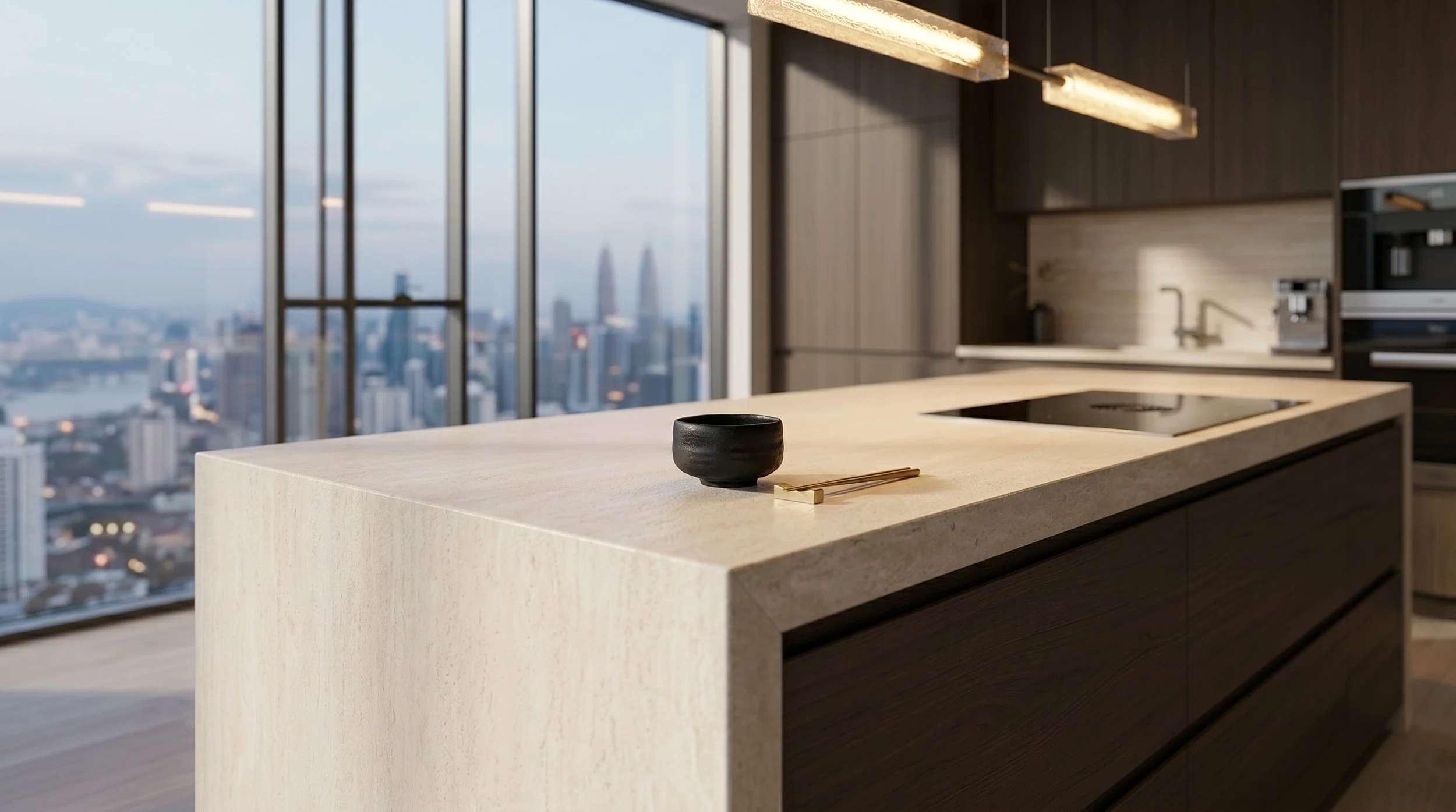
The waterfall edge installation is a definitive design element that extends the horizontal countertop surface vertically down the side of the cabinetry right to the finished floor plane. In a zero-joint kitchen, the waterfall must appear to be an organic extension of the countertop pattern, requiring meticulous alignment across multiple dimensions.
Vein Mapping and Pattern Continuity
When using highly graphic porcelain slabs that feature bold marble veining (such as Calacatta Gold or Arabescato), achieving pattern continuity across the mitered corner is essential. If a massive vein cuts across the countertop and suddenly stops at the edge, shifting three inches to the left on the vertical drop, the monolithic illusion is immediately shattered.
To execute absolute vein alignment, fabricators use specialized digital layout software (e.g., Slabsmith).
The fabricator takes high-resolution, orthorectified digital photographs of the exact porcelain slabs assigned to the project.
The software allows the designer to overlay the three-dimensional cutting templates onto the digital slab image.
The horizontal counter template and the vertical waterfall template are placed end-to-end at the exact miter line. This digital process ensures that when the pieces are sliced at 45 degrees and folded down, the veins transition smoothly across the seam without any offset or interruption.
Managing Floor Deflection and Construction Tolerances
The vertical waterfall slab rests directly on the finished floor of the home. This introduces a major structural risk: floor deflection. If the subfloor bounces or drops when someone walks past the kitchen island, the vertical waterfall slab will lift and press against the horizontal countertop slab, putting immense shear force on the mitered joint.
To safeguard the installation against these shifts:
The 1mm Isolation Gap: The vertical waterfall slab should never be forced tight against a hard finished floor (such as concrete or ceramic tile). Installers must leave a precise 1mm to 2mm isolation gap between the bottom edge of the porcelain and the floor. This micro-gap is filled with a color-matched, non-staining structural silicone, which acts as a shock absorber that compresses if the floor undergoes minor seasonal movement.
Cabinet Shimming: The island cabinetry must be anchored securely to the subfloor. If the island framework is capable of sliding or shifting even a millimeter under heavy lateral pressure, the waterfall miter seam will split open instantly.
5. The Seamless Vertical Plane: Full-Height Backsplash Integration
The final component of the zero-joint culinary environment is the transition from the horizontal countertop to the vertical wall plane via a full-height porcelain backsplash. The objective is to eliminate the traditional gap, trim piece, or heavy caulking line that typically defines this intersection.
Scribing and Wall Plumb Calibration
In modern construction, walls are rarely perfectly flat or plumb. If a fabricator cuts a full-height backsplash slab with straight 90-degree edges and attempts to mount it against a bowed or wavy wall, wide gaps will appear along the intersection line.
Digital Laser Scribing: Once the horizontal countertop is fully installed, the fabricator uses a high-precision 3D digital laser scanner (e.g., LT-2D2D Laser Templator) to map out the exact contour of the countertop surface and the surrounding wall boundaries. The laser captures every minor dip, ridge, and out-of-plumb variance.
CNC Execution: The laser coordinates are transferred directly into a CNC waterjet cutter, which scribes the bottom edge of the 6mm backsplash slab to mirror the exact topography of the counter surface. When the backsplash is set in place, it nests tightly against the countertop, matching its contour perfectly.
Outlet Cutout Engineering and Stress Isolation
Cutting rectangular holes into a 6mm porcelain slab for electrical outlets represents a primary failure zone during fabrication and transportation. Sharp, square, 90-degree interior corners within a porcelain cut generate massive stress concentration vectors. If an installer attempts to lift a backsplash slab with square electrical cutouts, the slab will frequently snap along those weak points.
To eliminate this structural risk:
Mandatory Radiused Corners: Every interior corner of an outlet or switch cutout must feature a minimum 2mm to 3mm radius circle. Fabricators must drill out the four corners of the outlet box using a diamond core bit before connecting the straight lines with a waterjet or diamond plunge cutter. This rounded geometry distributes structural tension uniformly across the material, preventing cracks from propagating outward.
Flexible Adhesive Mounting: When adhering the 6mm backsplash to the drywall or plaster substructure, installers must avoid using rigid mortars. Instead, they use high-tack, flexible polyurethane polymer adhesives applied in vertical beads. This elastic adhesive allows the wall to expand and contract under indoor temperature shifts without placing mechanical stress on the porcelain panel.
6. Critical Failure Points: A Checklist for Fabricators and Installers
To guarantee the structural performance and visual perfection of a zero-joint porcelain environment, teams must proactively manage these critical risks during fabrication and installation:
Stress Relief Cuts
Usually, raw porcelain slab comes from the factory with internal residual tension from the firing process. If a fabricator makes a long cut down the center of a raw slab without releasing this tension first, the slab can snap unpredictably mid-cut. Fabricators must always trim 2cm to 3cm off all four perimeter edges of the raw slab before beginning any finished layout cuts.
However there also also rectified Edge Porcelain Slabs that come pre cut from the factory and are ready for installation or fabrication. Many of CIERO’s Sintered Stone Porcelain Slabs are like this.
Inner Corner Radii on Countertop Cutouts
Just like electrical outlets on a backsplash, cooktop and under-mount sink cutouts on the horizontal countertop must never feature sharp 90-degree corners. All interior cutout corners must be fabricated with a minimum 5mm radius. Leaving these internal corners sharp creates structural stress zones that can cause the counter to crack during a thermal shift or impact.
Transportation Metrics
Fabricated porcelain pieces—especially countertops with massive sink cutouts—must always be transported vertically on heavy-duty wooden or steel A-frames. Transporting a porcelain slab flat or allowing it to flex over road bumps will cause immediate structural failure along its narrow sections.
Solvent Cleaning Prior to Bonding
Before applying structural acrylic or epoxy to a mitered joint, the cut surfaces must be completely clean and dry. Fabricators must scrub the mitered edges with 99% pure isopropyl alcohol or acetone to remove any fine stone slurry dust, grease, or fingerprints. If this dust is left behind, it creates a barrier that prevents the adhesive polymer from bonding with the porcelain crystals, causing the seam to fail down the road.
Conclusion: The Ultimate Fusion of Craft and Technology
The zero-joint kitchen is the definitive expression of modern luxury interior design. It transforms a high-use functional room into a clean, sculptured architectural monument. By treating surfaces as a continuous canvas, designers can create a sense of expansive calm and refined minimalism that traditional building materials simply cannot achieve.
However, as outlined in this guide, the absolute beauty of a monolithic kitchen relies entirely on the technical skill of its creators. There is zero tolerance for error in a zero-joint environment. Success requires designers to respect the structural needs of the material, fabricators to utilize advanced cutting and bonding machinery, and installers to enforce perfect level alignments across every plane.
When this collaboration is executed flawlessly, the result is a kitchen that transcends transient design trends—delivering an uncompromised balance of structural integrity, effortless maintenance, and timeless visual sophistication.